Mono no Aware Meaning & Definition
The mono no aware meaning encompasses the bittersweet awareness of impermanence — a gentle, wistful sadness that arises from the recognition that all things are fleeting. It is not despair but rather a heightened sensitivity to the beauty that exists precisely because it will not last. In Japanese, this concept sits at the very heart of aesthetic consciousness, shaping how an entire culture experiences beauty, loss, and the passage of time.
Pronunciation
IPA: /mo.no no a.wa.ɾe/
Audio: Recommended — listen on Forvo for native Japanese pronunciation. The word aware is three syllables (ah-WAH-reh), not two — it should never be pronounced like the English word “aware.” The phrase flows as five syllables: MO-no-no-a-WA-reh.
Etymology
The mono no aware meaning is built from three elements: mono (物), meaning “thing” or “things”; the possessive particle no (の); and aware (哀れ), a Heian period exclamation expressing deep emotional stirring — something between a sigh and an “ah.” In its earliest usage, aware was simply the sound a person made when moved by beauty or sorrow, the way one might exhale softly at the sight of snow falling on an empty garden.
The phrase was crystallized by 18th-century literary scholar Motoori Norinaga (1730–1801), who identified it as the central aesthetic principle of The Tale of Genji — the 11th-century masterwork by Murasaki Shikibu that is often considered the world’s first novel. Norinaga argued that Shikibu wrote the entire 54-chapter work to awaken readers to mono no aware: the capacity to be deeply moved by the passage of things.
Literal Translation
Mono (物 — thing) + no (の — of) + aware (哀れ — pathos/deep feeling) = “the pathos of things” or “the ahness of things.” Some scholars also translate it as “the sensitivity of things” or “an empathy toward things,” though no single English phrase captures the full mono no aware meaning.
Cultural Context
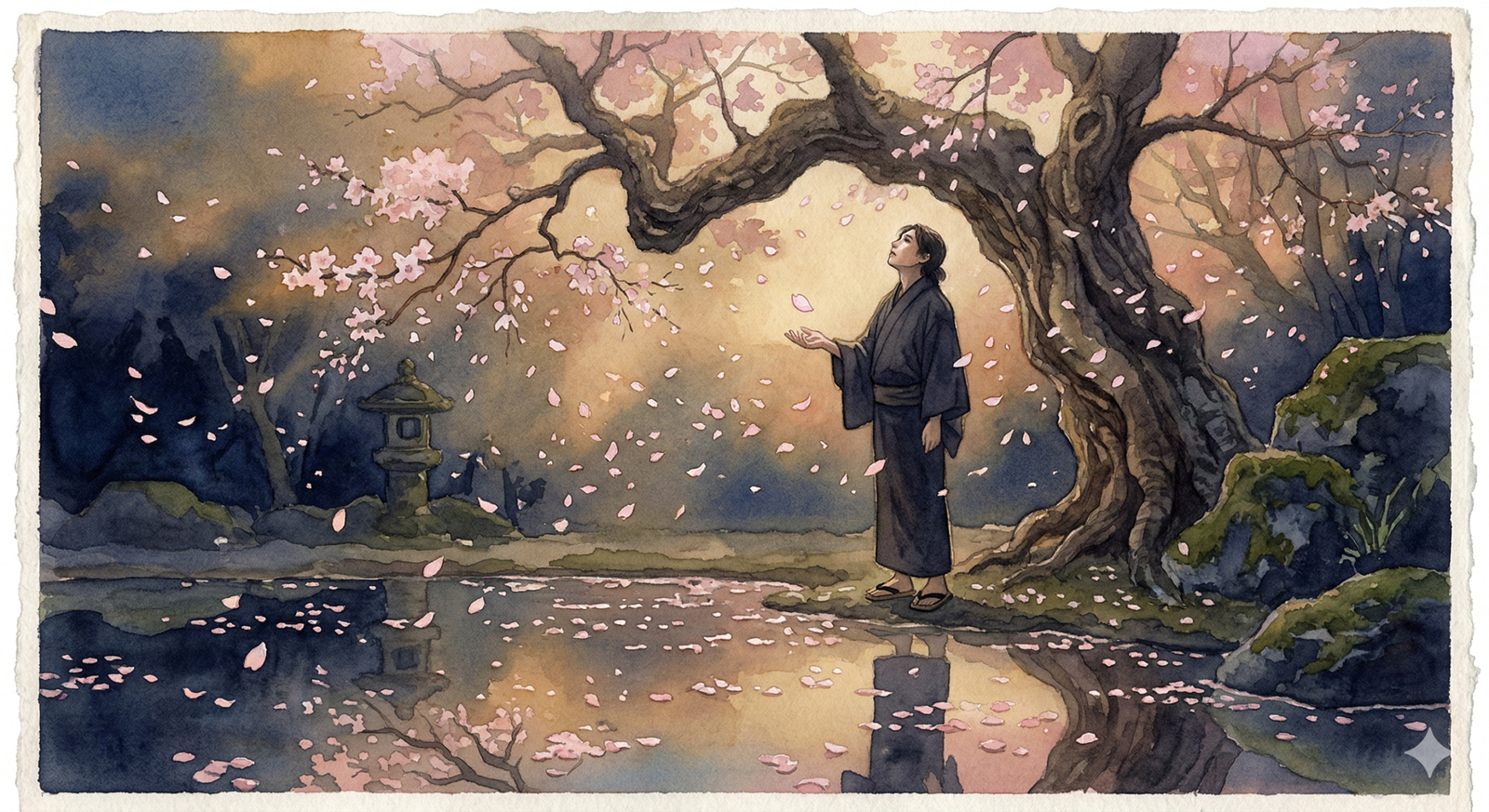
No word is more deeply woven into Japanese aesthetic consciousness than mono no aware. It is the reason the Japanese celebrate cherry blossoms not at their peak, but at the moment the petals begin to fall. The most famous hanami (flower-viewing) gatherings are timed not to fullest bloom but to sakurafubuki — the “cherry blossom blizzard” when petals shower down like snow. The beauty is in the leaving.
This sensibility reaches back over a thousand years. In The Tale of Genji, Murasaki Shikibu filled her narrative with moments where characters pause to notice the changing seasons, the fading of a lover’s kimono, the sound of autumn insects. These are not incidental details — they are the entire point. To feel mono no aware is to be fully human, fully awake to the world’s fragile beauty. The Heian court considered a person who could not feel it to be emotionally impoverished.
Today, the mono no aware meaning shapes everything from Japanese garden design — which choreographs seasonal change rather than resisting it — to the national fascination with sakura forecasts, autumn leaf reports, and the fleeting first snow. It is present in the tradition of keshiki, the art of arranging a single seasonal flower in a vase, knowing it will wilt by morning. In a culture that values impermanence as a source of beauty rather than anxiety, mono no aware is not melancholy — it is gratitude for having noticed at all.
Modern Usage Example
Japanese: 「桜が散るのを見ると、物の哀れを感じる」
English: “Watching the cherry blossoms scatter, I feel mono no aware” — the aching beauty of something beautiful disappearing.
Related Words
The mono no aware meaning connects to several other untranslatable concepts in our dictionary. Wabi-Sabi shares its appreciation for imperfection and transience, while Yūgen captures the mysterious depth that mono no aware often evokes. Komorebi — sunlight filtering through leaves — is itself a moment of mono no aware, beautiful because the light shifts and fades. And Saudade, the Portuguese word for deep longing, echoes the same tender ache for what is passing or already gone.
Why English Needs This Word
English has “bittersweet” and “nostalgia,” but neither captures the mono no aware meaning with its full philosophical weight. Mono no aware is not about remembering the past — it is about being exquisitely present to the moment of passing itself. It is what you feel watching a sunset dissolve, hearing the last notes of a song fade, or holding a conversation you know is drawing to a close. Where Western culture often treats impermanence as a problem to solve, mono no aware treats it as the very source of beauty. The cherry blossom would not move us if it bloomed forever.