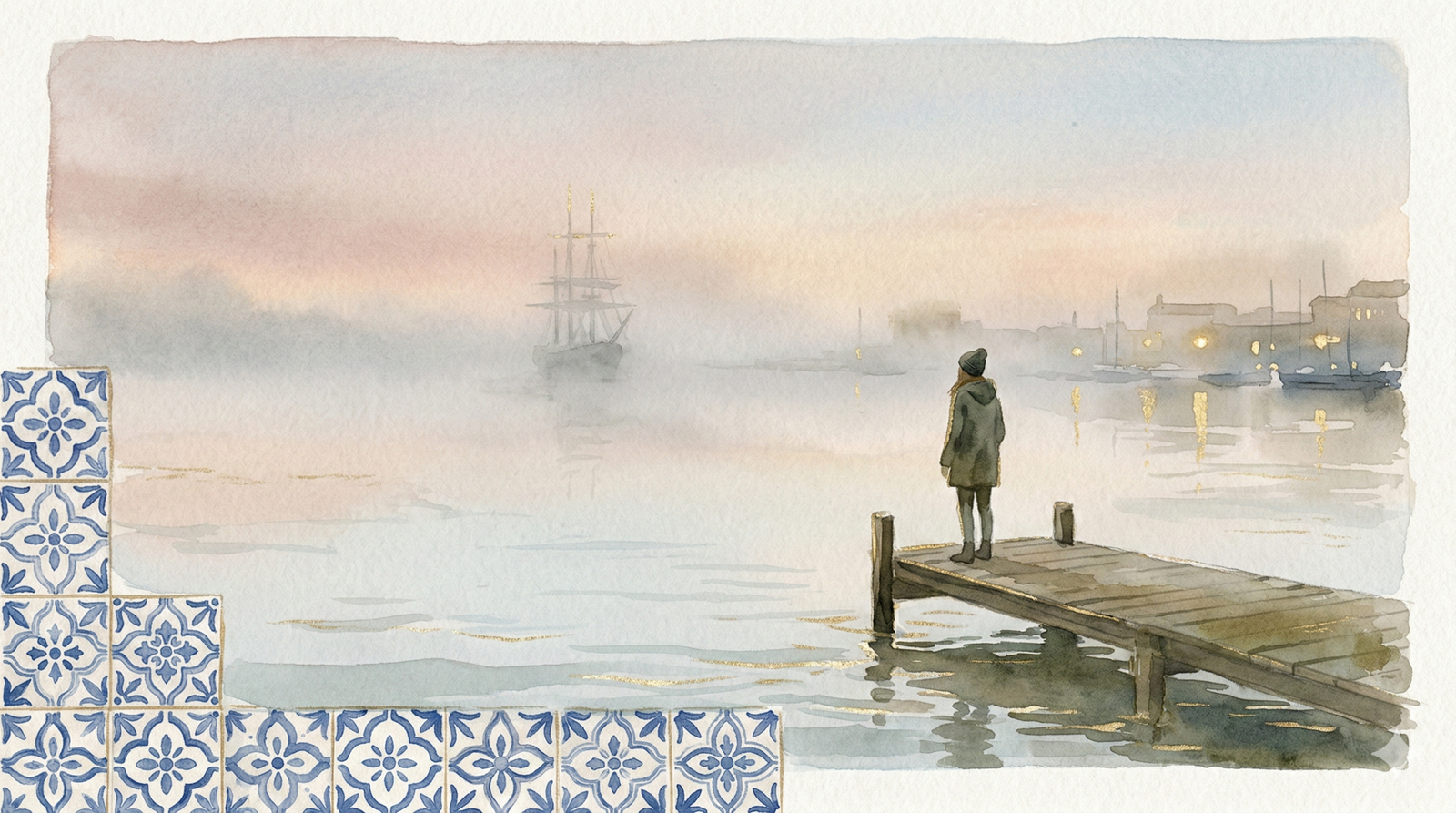
The saudade meaning is one of the most beautiful and complex emotions in the Portuguese language — a deep, bittersweet longing for something or someone that is absent. The saudade meaning captures that ache in your chest when you miss a person, a place, or a time that may never return. Often called the most untranslatable word in any language, saudade has no direct English equivalent, making it a crown jewel of linguistic uniqueness.
What Does Saudade Mean? 5 Layers of Portuguese Longing
The etymology of saudade is debated among linguists, but the most widely accepted origin traces the saudade meaning back to the Latin solitate (solitude) or solitatem, which evolved through Galician-Portuguese into its modern form. Some scholars also connect it to the Arabic sawda, meaning a dark melancholy — a reminder of the Moorish influence on the Iberian Peninsula. What makes the saudade meaning truly unique is that it encompasses not just sadness at absence, but a paradoxical pleasure in the memory itself.
Saudade is woven into the very fabric of Portuguese and Brazilian culture. In Portugal, it finds its most powerful expression in fado music — the mournful, soul-stirring songs that echo through the narrow streets of Lisbon’s Alfama district. Fado singers channel the saudade meaning into every note, giving voice to centuries of maritime longing from the Age of Exploration, when sailors left home not knowing if they would ever return. In Brazil, saudade takes on a warmer, more nostalgic quality — the longing for Carnival after it ends, the memory of a grandmother’s kitchen, the ache for a childhood home left behind.
Saudade resonates with several other untranslatable words about longing and nostalgia in our dictionary. The Welsh word hiraeth captures a similar homesickness for a place that may no longer exist, while the German fernweh describes the opposite — a longing for places you have never been. The Romanian concept of dor is perhaps saudade’s closest cousin, expressing a deep yearning intertwined with love. The Russian word toska shares saudade’s quality of spiritual anguish without a clear cause. Learn more about the cultural significance of saudade in Portuguese-speaking cultures.
To understand the saudade meaning fully is to understand something fundamental about the human heart: that we can feel joy and sorrow at the same time, that missing something deeply is itself a form of love. The saudade meaning teaches us that absence does not diminish connection but rather transforms it into something luminous and enduring. This is why the Portuguese do not see saudade as merely a negative emotion — it is a testament to having loved, having lived, and having been fortunate enough to have something worth missing.
Portuguese (Saudade) · Emotions & Feelings
Pronunciation: sow-DAH-djee
“A deep, melancholic longing for something or someone absent — a bittersweet ache for what once was or what might have been.”
What Does Saudade Mean?
Saudade is a Portuguese and Galician word that describes a profound emotional state — a deep, bittersweet longing for something or someone that is absent. It is more than mere nostalgia or homesickness; it encompasses the love that remains after something is gone, the ache of absence intertwined with the warmth of remembrance.
The word has no direct English equivalent. It captures the paradox of finding beauty in loss, of treasuring what we no longer have precisely because we no longer have it. Saudade is the taste of a grandmother’s cooking that can never quite be replicated, the echo of a love that has faded, the yearning for a homeland left behind.
The Soul of Portuguese Culture
Saudade is often called the soul of Portuguese culture. It permeates the nation’s literature, music, and identity. The word is so central to the Portuguese experience that linguists and philosophers have argued it defines the national character itself.
The concept is most powerfully expressed in fado, Portugal’s haunting traditional music. Fado singers channel saudade through their voices — each note carrying the weight of longing, loss, and the bittersweet acceptance of fate. The music does not seek to resolve the pain but rather to honor it, to give it a voice and a melody.
The Many Faces of Saudade
What makes saudade unique is its breadth. You can feel saudade for a person, a place, a time, or even something you have never experienced — a future that will never arrive, a life you might have lived. It can be triggered by a song, a scent, the quality of light on a particular afternoon.
There is saudade for childhood summers, for the person you were before the world reshaped you, for the possibilities that closed when you chose one path over another. It is not depression or despair — it carries within it a strange sweetness, an acknowledgment that to miss something deeply is proof of how deeply you once loved it.
Why Saudade Matters
In a culture that often urges us to move on and get over it, saudade offers a different wisdom. It suggests that our longings and losses are not weaknesses to be overcome but essential threads in the tapestry of a fully lived life. To feel saudade is to have loved deeply, experienced fully, and lived with the courage to care about things that can be lost.