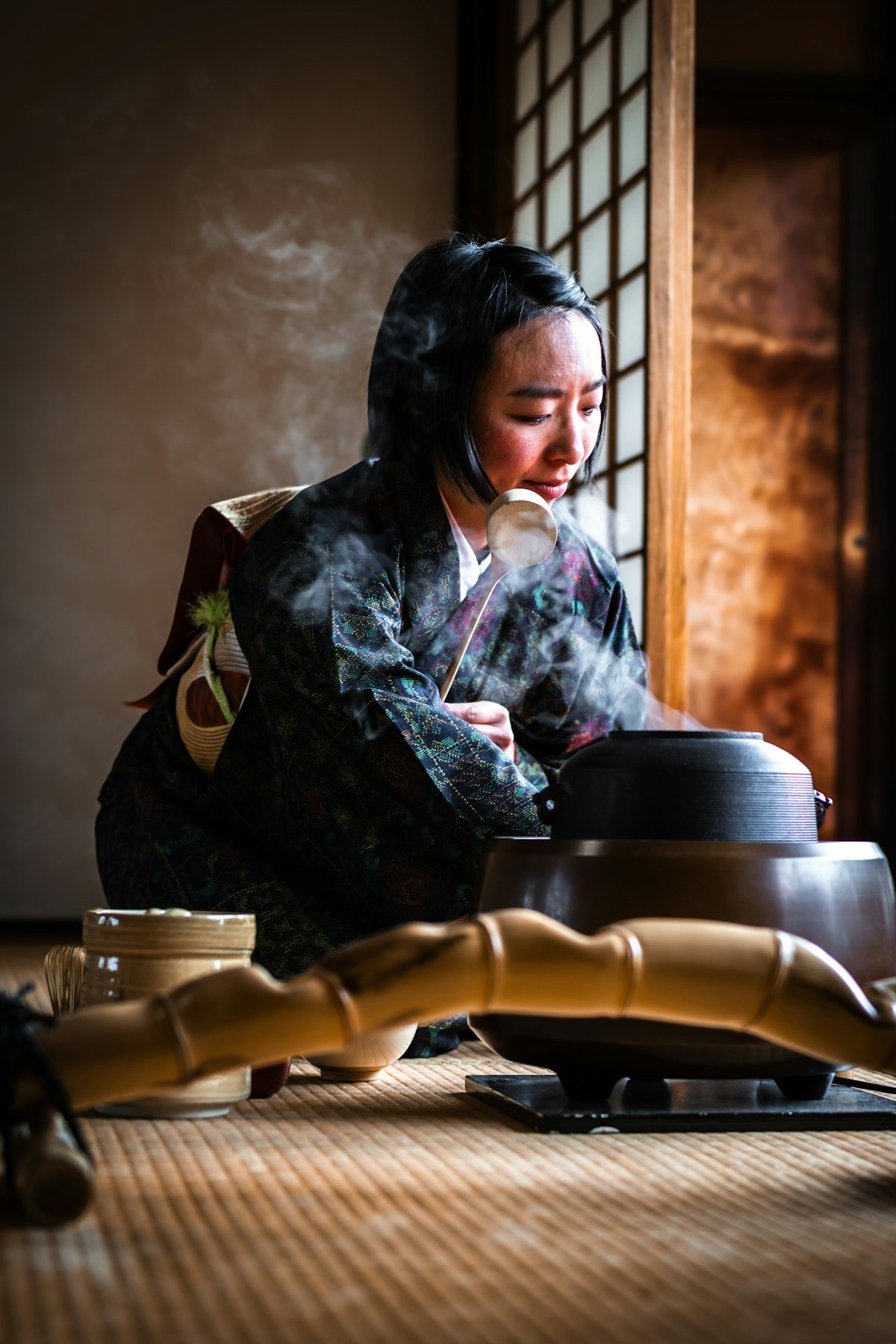
Japanese | 一期一会
Pronunciation: /iˈtɕiɡo iˈtɕie/
Literal translation: “one time, one meeting” — from 一 (ichi, one) + 期 (go, a period of time, one's lifetime) + 一 (ichi, one) + 会 (e, meeting, gathering).
What Does Ichigo Ichie Mean? The Heart of the Tea Ceremony
Ichigo ichie meaning is difficult to compress into a single English phrase, because it is less a definition than a discipline. The term asks us to treat every encounter — every cup of tea, every shared meal, every chance conversation — as something that is happening precisely once, in this exact configuration of people and moment, and will never occur again in quite this way.
Etymology
The phrase 一期一会 (ichigo ichie) is built from four kanji characters: 一 (ichi, one), 期 (go, a period or the span of a lifetime), 一 (ichi, one again), and 会 (e, meeting or gathering). Read together they become: one lifetime, one meeting — or, as it is most often rendered in English, “one time, one meeting.”
The phrase is traditionally traced to Sen no Rikyū (千利休, 1522–1591), the tea master who reshaped the Japanese tea ceremony into the austere, profound practice known as wabi-cha. Rikyū's teaching that each gathering deserves the full weight of attention — as if it were the last — is the root of ichigo ichie. The term was later committed to writing by the feudal lord and tea master Ii Naosuke (井伊直弼, 1815–1860) in his text Chado Ichie-ki (茶道一会記), which formalized the principle: both host and guest should receive each gathering as irreplaceable, because in the full span of a life, it is.
The concept belongs to the broader world of wabi-cha philosophy, which Rikyū built partly on Zen Buddhist ideas about impermanence. The temporal structure of Buddhism — in which nothing persists unchanged from one moment to the next — finds a practical, graceful expression in ichigo ichie. To practice it is to turn an abstract teaching about impermanence into a lived courtesy.
Cultural Context
In its original context, ichigo ichie was an instruction to the tea host: prepare every gathering as though it will never happen again, because it will not. Every placement of a flower, every selection of a scroll, every gesture in the tea room — these deserve complete attention because this arrangement of season, guest, and moment is unrepeatable. This is not sentimentality. It is a form of rigor, a demand that the host be entirely present.
The idea saturates Japanese culture far beyond the tea room. It threads through omotenashi, Japan's philosophy of wholehearted hospitality, and through the seasonal rituals that structure the Japanese year. The tradition of hanami — gathering beneath cherry trees to watch blossoms that will fall within a week — is one of ichigo ichie's most vivid expressions. The same trees bloom every spring, yet every hanami is genuinely different: this group of friends, this afternoon's light, these blossoms at this precise moment in their fall. The brevity is not a flaw. It is the point.
In contemporary Japan, ichigo ichie has moved from the tea room into everyday speech. A dinner with old friends, a conversation with a stranger on a train, a child's first school performance — any of these can be held with the awareness that it is happening only once, exactly this way. The phrase appears on kakejiku (hanging scrolls) in traditional tea rooms and ryokan inns, quoted at graduations and farewell parties. Its ubiquity has not emptied it: to a Japanese speaker, seeing 一期一会 is still a genuine prompt to slow down and pay full attention to what is already here.
How It's Used Today
The phrase is spoken in moments of parting, gratitude, or heightened awareness — anywhere a person wants to acknowledge that what is happening now will not come again in quite this form. It is used to describe a first meeting, a last gathering, or simply an ordinary moment recognized as precious.
今日の出会いは、一期一会だから、大切にしよう。
“Today's encounter is ichigo ichie — one time, one meeting — so let's cherish it.”
Why English Has No Equivalent
English approaches ichigo ichie with phrases like “once in a lifetime” or the Latin borrowing carpe diem — but both miss the mark. “Once in a lifetime” implies scale and rarity: a great journey, a historic event. Ichigo ichie applies to the small and everyday — a bowl of tea, an afternoon conversation, a shared silence. Carpe diem urges urgency and action; ichigo ichie asks for something quieter: presence, gratitude, and the graceful acceptance that this particular gathering is already complete, already whole, exactly as it is. There is no English phrase that holds these three things together without adding something that does not belong.
Related Words
If ichigo ichie meaning resonates with you, you may also find meaning in mono no aware (物の哀れ), the Japanese sensitivity to the transience of things — the gentle ache that arises when beauty is inseparable from its passing. Closely linked is wabi-sabi (侘寂), the aesthetic of imperfection, impermanence, and incompleteness — a sensibility ichigo ichie shares. Natsukashii (懐かしい) names the warm, bittersweet nostalgia for a past moment that was precious precisely because it has passed. And kintsugi (金継ぎ) — the art of repairing broken pottery with gold — shares ichigo ichie's conviction that what is finite and fragile is worth honoring with care.
Further Reading
- The Way of Tea — Encyclopædia Britannica — authoritative overview of the Japanese tea ceremony and the philosophy of wabi-cha from which ichigo ichie emerged.
- Meeting — Online Etymology Dictionary — for context on the English concept of “meeting” versus the Japanese 会 (kai/e), and why the translation falls short of the original.