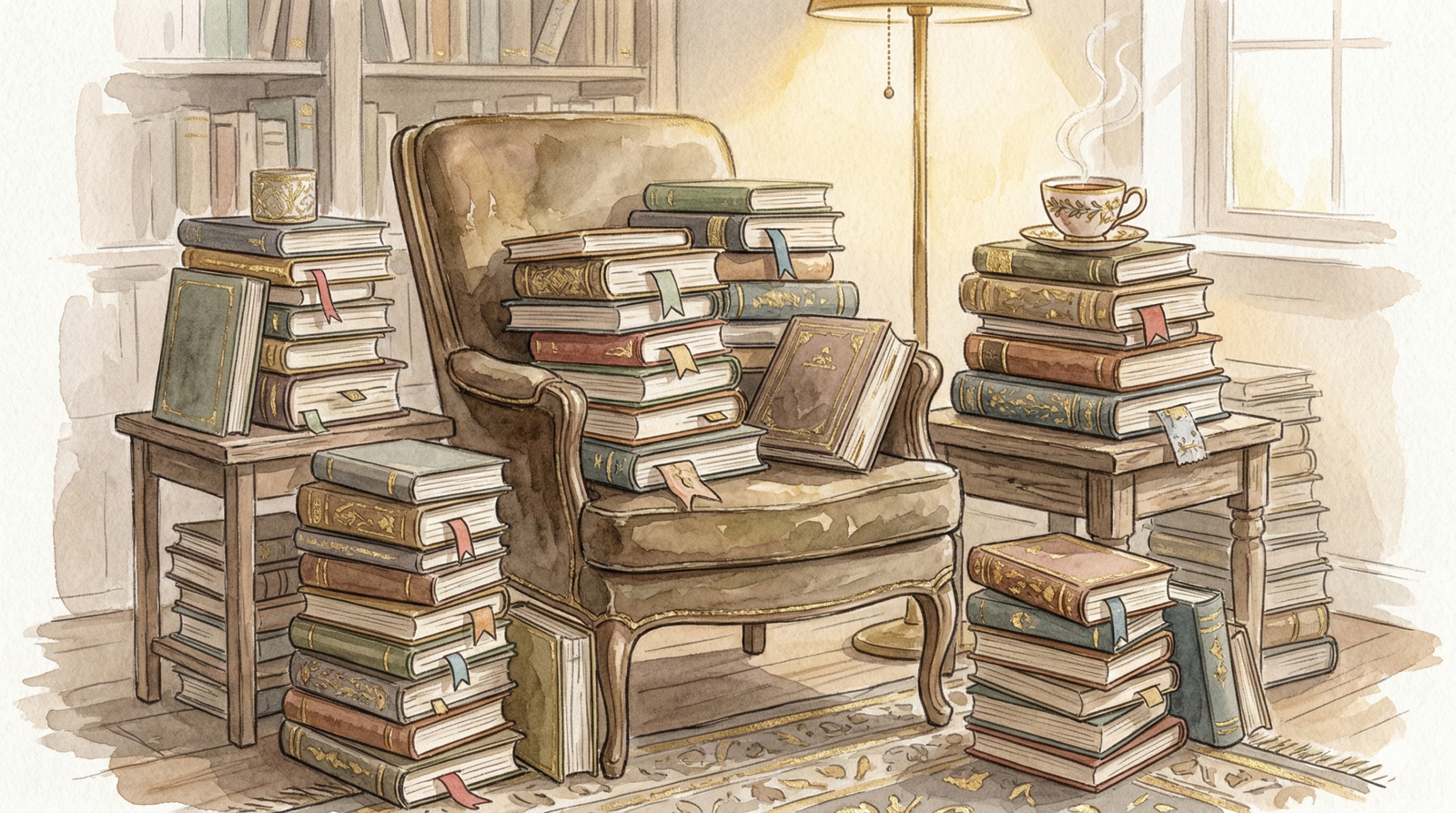
The tsundoku meaning perfectly captures a habit shared by book lovers around the world — the act of acquiring books and letting them pile up unread. Far from a criticism, the tsundoku meaning celebrates intellectual curiosity and the optimistic belief that one day, you will find time to read them all. This charming Japanese word resonates deeply in the age of online bookstores and ever-growing reading lists, giving name to a behavior that millions practice but few can articulate.
What Does Tsundoku Mean? 3 Elements of Japanese Book Culture
The tsundoku meaning is built from the Japanese words 積ん (tsun, to pile up) and 読 (doku, to read). The combination creates “reading pile” — books acquired with the intention to read but left stacked. First documented in the Meiji era (late 1800s), the tsundoku meaning originally carried a gentle teasing quality, used among scholars and students who couldn’t resist buying more books than they could read. Today, the tsundoku meaning has been embraced globally as book lovers everywhere recognized themselves in this single, perfect word.
Japan’s deep relationship with books and reading culture provides the perfect soil for a word like tsundoku. The country has one of the world’s highest literacy rates and a publishing industry that produces over 70,000 new titles annually. Bookstores are social spaces, and owning books is seen as a sign of intellectual engagement. In this context, tsundoku is not laziness but aspiration — each unread book represents a future journey of the mind. The concept has gained international fame through social media, where #tsundoku has become a badge of honor among bibliophiles.
Tsundoku connects beautifully with other untranslatable words in our dictionary. The Japanese aesthetic of wabi-sabi finds beauty in the imperfect — like a bookshelf that grows faster than you can read. The concept of ikigai (life purpose) might drive the book-buying, while komorebi creates the perfect reading light filtering through leaves. The Danish word hygge captures the cozy atmosphere many tsundoku practitioners create around their reading spaces. Learn more about this concept at Wikipedia’s tsundoku article.
Whether your tsundoku takes the form of towering bedside stacks or an overflowing e-reader, the tsundoku meaning validates what every book lover knows: the joy of books extends far beyond reading them. The tsundoku meaning reminds us that surrounding ourselves with unread books is not a failure — it is a celebration of curiosity, a library of possibilities waiting to unfold.
Japanese (積ん読) · Knowledge & Learning
Pronunciation: tsoon-DOH-koo
“The act of acquiring books and letting them pile up unread — a growing collection of good intentions bound in paper.”
What Does Tsundoku Mean?
Tsundoku (積ん読) is a Japanese word that describes the habit of acquiring books and letting them pile up without reading them. It is the stack of books on your nightstand, the overflowing shelves you swear you’ll get to someday, the growing tower of unread volumes that serves as both a source of guilt and a monument to your intellectual aspirations.
The word combines tsun (積ん, to pile up) with doku (読, to read). It first appeared in the Meiji era (1868-1912) as a playful jab at book collectors who accumulated far more than they could ever read — a habit that, thanks to online bookstores and one-click purchasing, has only grown more common.
The Joy of Unread Books
While tsundoku might sound like an accusation, many bibliophiles wear it as a badge of honor. The Italian writer Umberto Eco famously kept a library of 30,000 books, most of which he had never read. He argued that an unread book is more valuable than a read one — it represents knowledge yet to be discovered, questions yet to be asked.
Nassim Nicholas Taleb expanded on this idea, coining the term “antilibrary” to describe the collection of unread books that reminds us how much we don’t know. In this light, tsundoku is not a failure of reading discipline but a celebration of intellectual humility and infinite curiosity.
Why We Accumulate Books
Psychologists suggest several reasons for tsundoku. Books represent our ideal selves — the people we aspire to become. Buying a book about philosophy, cooking, or astrophysics is a small act of hope, a vote of confidence in our future capacity for growth. The books pile up because our ambitions always outpace our available hours.
There is also the simple sensory pleasure of books as objects — the weight of a hardcover, the smell of fresh pages, the visual delight of a well-stocked shelf. For many tsundoku practitioners, books are not merely vessels for information but beautiful artifacts worthy of collection in their own right.
Embracing Your Tsundoku
If you practice tsundoku, take heart. Your growing pile of unread books is not a symbol of failure but evidence of a mind that is curious, ambitious, and endlessly hungry for knowledge. Each unread book is a door waiting to be opened, a world waiting to be explored.
The Japanese have given us this word not to shame us but to name a universal human experience with affection and humor. In a world that increasingly values consumption over contemplation, tsundoku reminds us that sometimes the most meaningful act is simply to gather the raw materials for wonder and let them wait patiently until we are ready.