/ˈfriːlʊftsˌliːv/
Literally: “free air life” (fri = free, luft = air, liv = life)
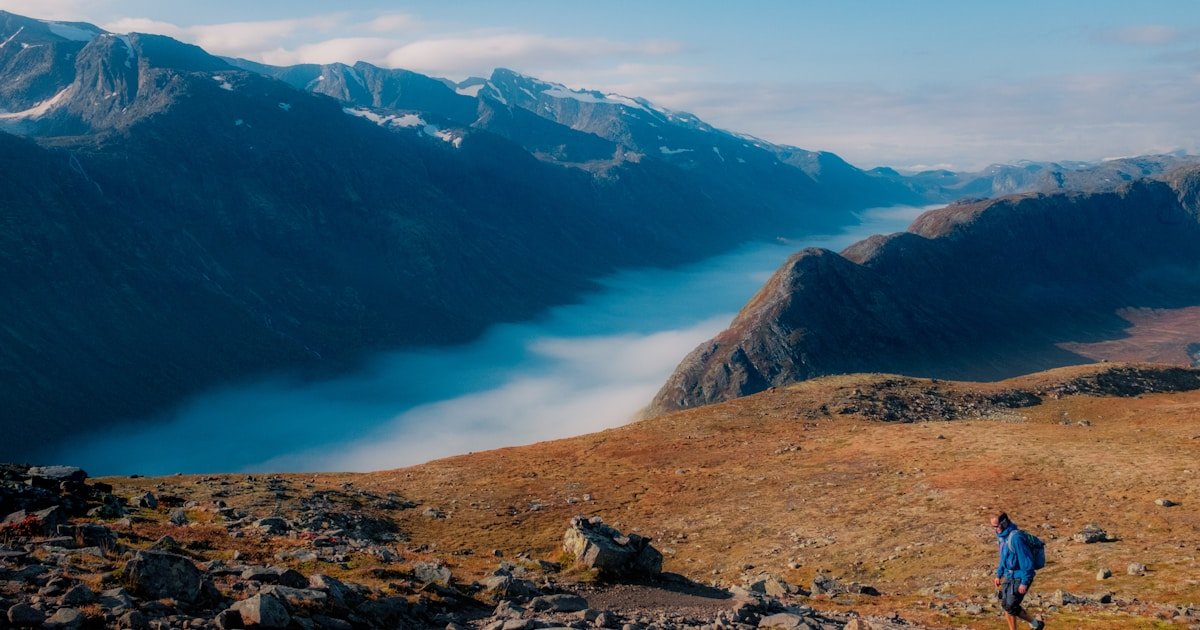
The friluftsliv meaning goes deeper than its literal translation suggests. Friluftsliv is the Norwegian word for a life lived in conscious relationship with the natural world — not outdoor recreation, not sport, not hiking as fitness — but the daily and seasonal practice of being outside as a way of being fully human. It is less a leisure activity than a philosophy of existence: the idea that human beings belong outdoors, that the body and mind require contact with air, weather, and the living world in order to function as they are meant to.
Etymology
The word was first used in print by the Norwegian playwright Henrik Ibsen in his 1859 poem On the Heights, where he used it to describe the spiritual freedom found in mountain life. Ibsen’s friluftsliv was not a recreational concept — it was a moral one. His wanderer in the mountains was not exercising; he was becoming more himself. The word carried from its very first use the sense of nature as a place of self-discovery rather than conquest.
The explorer Fridtjof Nansen, who led the first crossing of Greenland in 1888, helped deepen the word’s cultural resonance. For Nansen, being in nature was not preparation for something else — it was the thing itself. His accounts of polar expeditions described not just physical achievement but the interior change that comes from extended time in wilderness: a quieting of ambition, a sharpening of the senses, a kind of clarity unavailable indoors.
The concept was later given legal foundation in the Friluftsloven (Outdoor Recreation Act) of 1957, which enshrined allemannsretten — the “right to roam” — in Norwegian law. Under this law, any person may walk, ski, or camp on uncultivated land regardless of who owns it. The land is not just available to the public; it is philosophically considered to belong to everyone who walks through it. This legal framework reflects how deeply friluftsliv is embedded in Norwegian identity: it is not just a pastime but a right, a cultural birthright built into the relationship between citizens and landscape.
Cultural Context
In Norway, friluftsliv is not a weekend hobby. It is practiced year-round, in all weather, by people of all ages and backgrounds. Norwegian children play outside in rain and snow as a matter of course; many Norwegian nurseries operate entirely outdoors regardless of temperature. The common saying det finnes ikke dårlig vær, bare dårlige klær — “there is no bad weather, only bad clothing” — captures the cultural attitude precisely. The weather is not an obstacle to going outside; it is part of the experience.
What distinguishes friluftsliv from ordinary outdoor recreation is the quality of attention it requires. A runner moving through a forest at speed is not practicing friluftsliv. Someone walking slowly through the same forest, noticing the particular light on the snow, the sound of a stream under ice, the smell of pine resin in cold air — that is closer to the spirit of the word. Friluftsliv is about presence, not performance. It strips away the metrics of fitness culture — pace, distance, calories — and replaces them with something harder to measure: attentiveness to the living world.
This attention has practical psychological effects that are well-documented in Scandinavian research. Time in natural environments reduces cortisol levels, lowers blood pressure, and improves mood more reliably than equivalent time spent in urban green spaces. But Norwegians have known this intuitively for generations. The concept of utepils — drinking a beer outside in the first sunshine of spring — is a small but telling example: the point is not the beer, it is the deliberate choice to be outside, to mark the return of warmth with the body, not just the mind.
Friluftsliv is also deeply social. Norwegian culture places enormous value on the hytte, the cabin — often a simple wooden structure in the mountains or by the sea — where families and friends spend weekends and vacations, often without electricity or internet. The hytte is not about luxury. It is about returning to a simpler relationship with the elements: cooking over a fire, sleeping when it gets dark, waking with the light. The communal experience of friluftsliv — walking together, sharing the silence of a landscape, building a fire — creates a kind of intimacy that indoor life rarely produces.
Friluftsliv Meaning in Modern Life
In the age of screens and sedentary work, friluftsliv offers something increasingly rare: a reason to go outside that has nothing to do with productivity. It is not exercise for the sake of health metrics. It is not nature photography for social media. It is simply being outside because outside is where you belong. This quality — purposeless presence in the natural world — is perhaps the hardest thing to recover once it is lost, and the most urgently needed.
The concept has found growing resonance beyond Scandinavia, as people in urban environments across the world seek ways to reestablish their connection with nature. But it translates imperfectly. You cannot practice friluftsliv in a park if you are listening to a podcast. You cannot practice it on a trail if you are tracking your split times. The word implies a certain surrender — of agenda, of distraction, of the measuring mind — that modern outdoor culture often resists.
“Vi trenger friluftsliv — ikke for å prestere, men for å puste.”
We need friluftsliv — not to perform, but to breathe.
Why English Has No Equivalent
English has “nature walk,” “outdoor living,” “wilderness experience” — all phrases that describe activities rather than a philosophy. “Going outside” is a behaviour. “Outdoorsmanship” implies skill and mastery. “Ecotherapy” medicalises what should simply be ordinary life. None captures the sense that being outside is not something you do for a reason — it is simply a way of being human that requires no justification. Friluftsliv names a relationship between people and the natural world so fundamental that Norwegians needed a single word for it, and the fact that English does not is itself a kind of cultural data: we have separated ourselves from that relationship enough to stop naming it.
Related Words
- Hygge — Danish/Norwegian cosiness, warmth, and convivial togetherness
- Gokotta — Swedish practice of waking at dawn to hear the birds
- Sisu — Finnish concept of inner strength and resilience
- Kaukokaipuu — Finnish longing for distant places