Swedish
Smultronställe meaning: the Swedish word for a personal place of joy, kept partly secret — literally a wild strawberry patch. Below: the etymology of Smultronställe, the Bergman film that fixed its modern resonance, the Swedish concept of allemansrätten, and why English has no equivalent.
/ˈsmʉlːˌtrɔnˌstɛlːə/ — SMOOL-tron-stell-eh
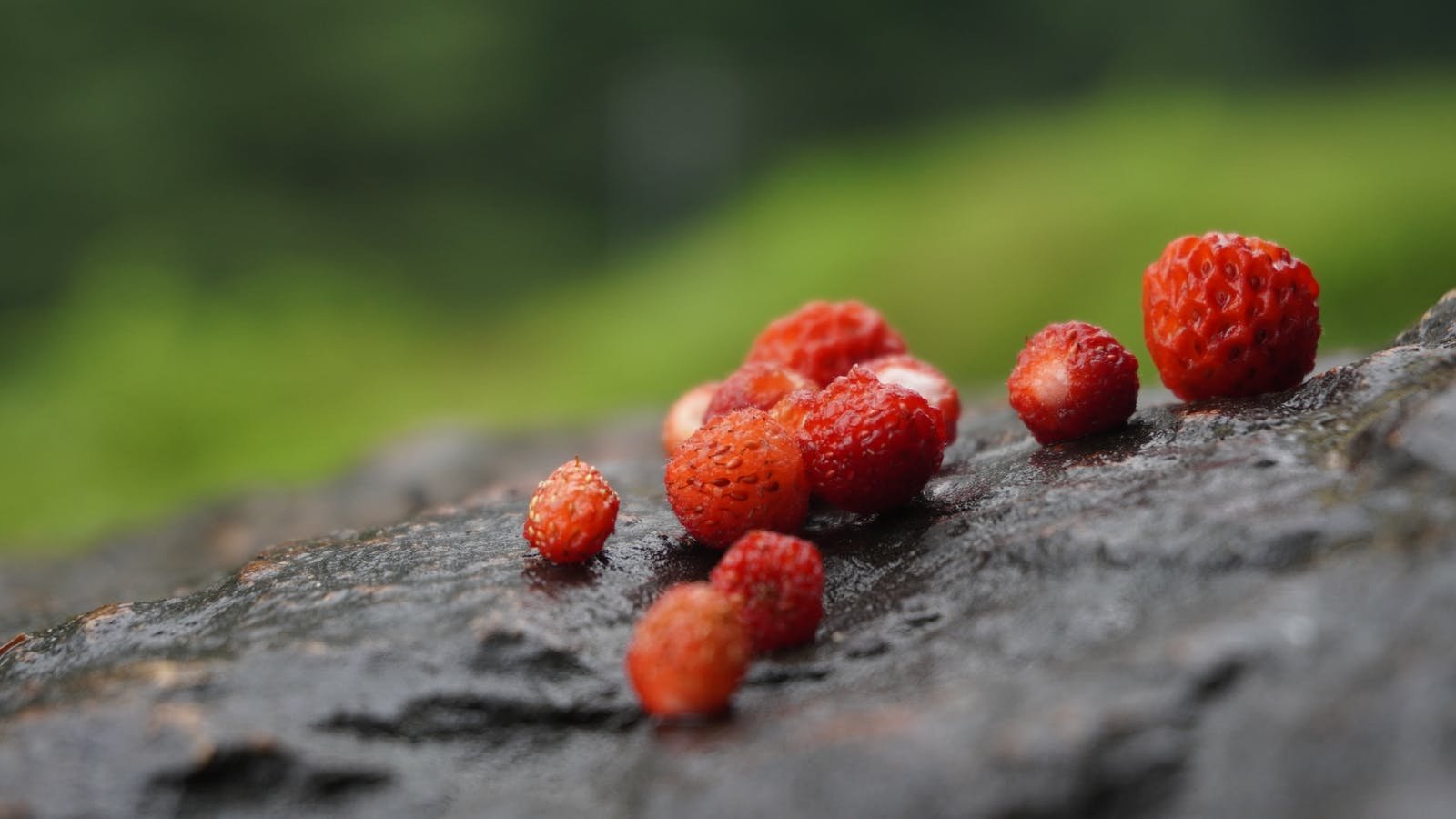
Literal translation: “wild-strawberry place” — from smultron (the wild woodland strawberry, Fragaria vesca, not the cultivated garden kind) + ställe (“place, spot”). The compound names a small, personal location someone returns to for private joy — usually unshared, always treasured, named for the particular happiness of stumbling on a tiny red fruit hidden in the moss.
Etymology of Smultronställe
Smultron descends from Old Swedish smultron, itself rooted in a Proto-Germanic stem related to softness and small things — a cousin of the verb smula (“to crumble”), with the implicit sense of a fruit small enough to crush against the palate without resistance. The word distinguishes the wild Fragaria vesca, which has been gathered from Nordic forests since prehistory, from the larger cultivated jordgubbe (“earth-fellow”), the supermarket strawberry. The two are not interchangeable in Swedish; the wild fruit carries a separate cultural weight the supermarket one cannot.
Ställe is plain Old Swedish for “place, spot, location,” cognate with German Stelle and ultimately the Proto-Germanic *stallaz, a position where something is set down. The compound smultronställe appears in Swedish print at least as early as the seventeenth century and was already idiomatic by the time Carl Linnaeus, walking the meadows of Uppsala in the 1730s, was annotating which fields gave good smultron. By the nineteenth century the word had drifted from the literal woodland fact into everyday metaphor: the place I go when I need to be alone, the bench in the park no one else seems to know about, the table at the café where the morning light falls just so.
The metaphor turned cinematic in 1957, when Ingmar Bergman released Smultronstället (released in English as Wild Strawberries) — a film whose title relies entirely on the word’s double life. The protagonist, an aging professor, returns to a remembered patch of his childhood, and the word does the work the English translation cannot: it points at a literal clearing of small red fruit and at the inner architecture of a person’s most private memory in the same syllable. Bergman’s title fixed the word’s modern emotional resonance for a generation of Swedes and gave it international currency among film audiences who would never otherwise have met it.
Cultural Context
To understand why Sweden has Smultronställe, it helps to understand allemansrätten — the Swedish “everyman’s right,” a centuries-old legal and cultural tradition that grants any person the right to walk, swim, camp, and forage on most uncultivated land, regardless of who owns it. Sweden’s countryside is, in a real legal sense, available to all Swedes. The smultronställe is what an individual makes of that universal access: a private claim staked inside a public common, marked not by fences or signs but by knowing — knowing which moss-covered boulder, which south-facing slope, which bend in which path. The word names a relationship between a person and a place, not a deed.
This is a distinctly Nordic kind of privacy. It is not the suburban privacy of locked doors and tall hedges; it is the privacy of choosing not to mention a place. A Swede with a smultronställe will tell you they have one but not where it is, and the omission is the whole point. The place is treasured by being kept partly secret, the way a saved letter is treasured by being kept folded. To bring the wrong person to your smultronställe is to lose it; to bring the right person is one of the most intimate things you can do.
The word also carries a faint melancholy on its underside. Smultron ripen briefly — a Swedish summer is short, and the wild strawberry season is a matter of weeks. A smultronställe is therefore a place of seasonal scarcity, a thing that exists in full only a few times in a lifetime. Bergman’s film leans hard on this: the professor returns to his patch and finds it both unchanged and entirely lost, because the people who made it meaningful are gone. The word, used metaphorically, can mean a place that no longer exists for you even if its physical coordinates have not moved — the bench in the park where you used to read with someone, the corner of a city you have not been able to revisit since they died. It is a tender word with a quiet edge.
How Smultronställe Is Used Today
Smultronställe is a living, everyday Swedish word. It appears in newspaper restaurant reviews (“a real smultronställe on Götgatan”), in travel writing, in the names of cafés and small bookshops, and in the kind of late-evening conversation where someone admits, slightly shy, that they have a particular bench by a particular lake. It is also one of the most-borrowed Swedish words in international design and lifestyle writing, often appearing in the same paragraph as hygge, fika, and lagom — though those name states and Smultronställe names a coordinate.
Det här caféet är mitt smultronställe — jag har inte berättat om det för någon.
— “This café is my smultronställe — I haven’t told anyone about it.”
Why English Has No Equivalent for Smultronställe
English reaches for “favorite spot,” “secret place,” “hidden gem,” and “happy place.” Each gets close and each falls short. “Favorite spot” is too casual; “secret place” sounds clandestine; “hidden gem” is real-estate-listing language; “happy place” is a piece of self-help vocabulary. None of them carry the specific Nordic mixture Smultronställe holds in one breath: a real geographic location, a personal emotional weight, the implied modesty of not naming it, and the faint awareness that the season is short. English has the feeling. Swedish gives it a coordinate and a name.
Related Words
- For the closest cousin from another tradition — a personal place where one feels safest and most oneself — see querencia, the Spanish word for the home-spot of the soul.
- For the German cousin that names the feeling rather than the place — the deep, slightly unnerving solitude of being alone in a forest — see waldeinsamkeit.
- For the Welsh longing-for-a-place that aches when you are away from your own smultronställe, see hiraeth.
- For another Swedish landscape-word — the rippling road of moonlight on water that some smultronställen happen to overlook — see mångata.
- Browse more from the same vocabulary in our Swedish collection.
Further Reading
- Svenska Akademiens ordböcker — smultronställe (the Swedish Academy’s authoritative dictionary entry, with literal and figurative senses).
- Encyclopædia Britannica — Wild Strawberries (the cultural and cinematic context that fixed the word’s modern resonance through Bergman’s 1957 film).