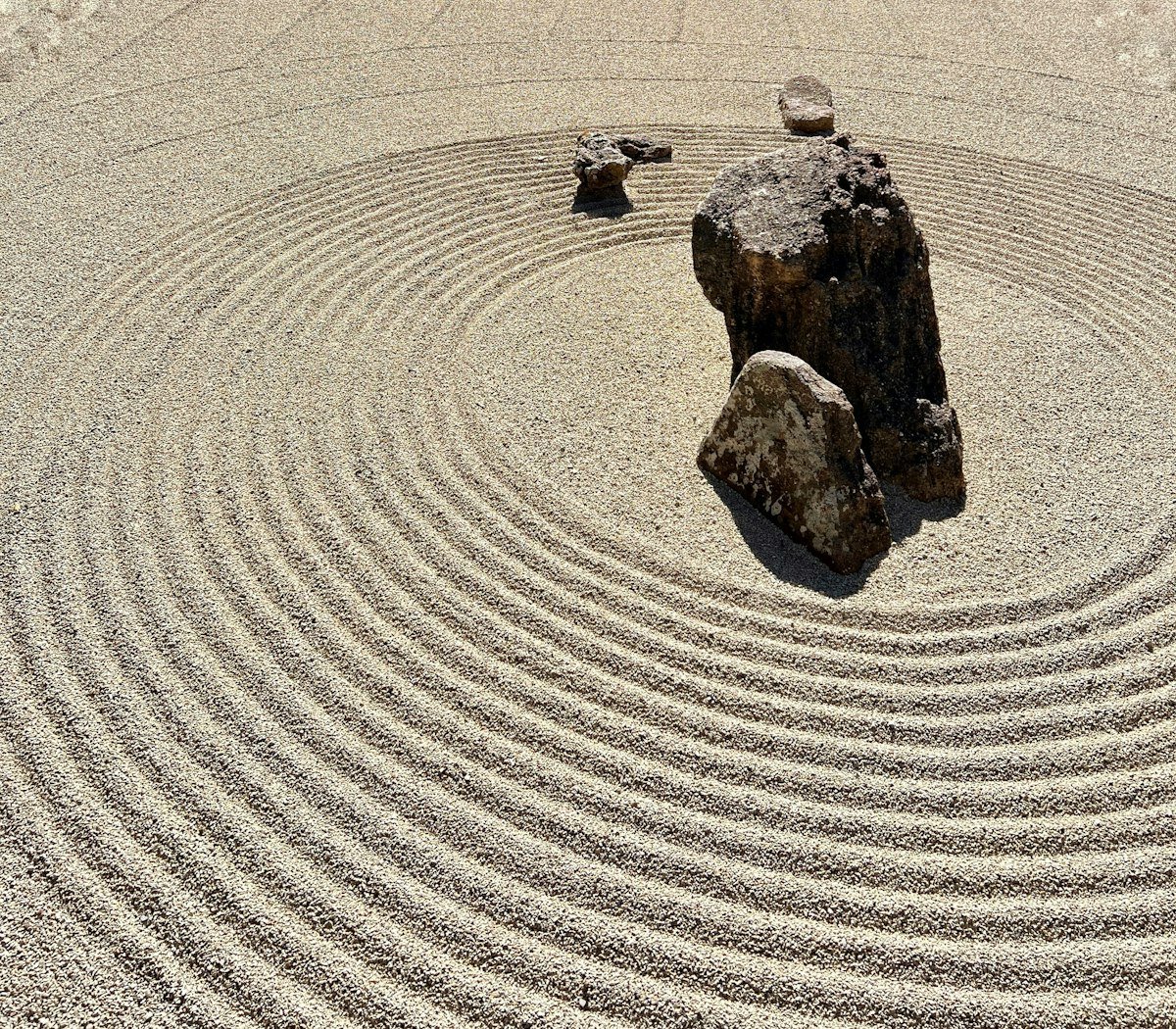
Ma meaning (間) — the Japanese concept of the meaningful pause, the intentional emptiness that gives form and resonance to everything around it.
Language: Japanese | Script: 間 | IPA Pronunciation: /maː/
Literal translation: “gap,” “pause,” “space between” — the meaningful interval that gives form to silence and emptiness.
Etymology of Ma (間) and Its Meaning
The kanji 間 (ma) is one of the most layered characters in the Japanese writing system. Its classical form depicts a gate (門, mon) through which moonlight (月, tsuki) filters — light passing through an opening, the outside world glimpsed through a gap. This image is not accidental. The character was chosen precisely because it encodes the relationship between container and void, between structure and what moves through it.
The word appears across the full range of Japanese vocabulary. 時間 (jikan) means time — literally “the interval between moments.” 空間 (kūkan) means space — “the empty interval.” 人間 (ningen) means a human being — “the being who exists in the interval between people,” capturing the Japanese understanding that personhood is relational rather than individual. Even 間違い (machigai), the word for “mistake” or “error,” breaks down as “wrong interval” — an action that misread the space between intention and execution.
Linguists trace ma to proto-Japonic roots meaning “between” or “among.” It shares conceptual territory with the Chinese 間 (jiān), though the Japanese usage developed a philosophical depth that expanded far beyond the Chinese sense of mere physical interval. By the Heian period (794–1185 CE), ma had entered the aesthetic vocabulary of court poetry and architecture, where its cultivation was considered a mark of refined sensibility.
Cultural Context
To understand ma, it helps to stand inside a traditional Japanese room. The tatami mat floor defines a grid. The shoji screens divide interior from exterior without fully severing the connection — light and shadow pass through, birdsong enters, the outline of a garden appears as a soft silhouette. Nothing in the room announces itself loudly. The arrangement of objects is sparse. What surrounds each object is considered as carefully as the object itself. This is ma made visible: the room breathes because of what is not there.
The concept saturates traditional Japanese arts. In ikebana (flower arrangement), the spaces between stems carry the same compositional weight as the blossoms. A master practitioner does not simply place flowers — they orchestrate emptiness. In Noh theater, the moments of absolute stillness between movements are formally named ma. Actors train for decades to hold these pauses without filling them with anxious motion. The pause is not waiting — it is speaking. In music, particularly in traditional flute and shamisen performance, the silence between notes is where emotional resonance lives; the note ends and the listener is left to inhabit what follows. In martial arts, ma-ai (間合い) refers to the precise physical and psychological distance between combatants — the space where an encounter is decided before a blow is struck.
The architect Tadao Ando built an entire career around ma. His concrete walls do not merely enclose space — they define the quality of light that enters it. His Church of the Light in Osaka (1989) is perhaps the purest architectural expression of the concept: a concrete box with a cross-shaped incision cut into the altar wall. Light enters through the cross. The room exists to hold that specific quality of light at that specific angle. The emptiness is the point.
How It’s Used Today
Modern Japanese speakers use ma in everyday contexts that retain its philosophical weight. A skilled communicator is said to have good ma — they know when to speak and when to wait. A comedian with excellent ma holds the pause before a punchline for exactly as long as needed. A person who interrupts constantly, or who fills silence reflexively, is said to have bad ma.
間を置いて、彼女はようやく答えた。 — “After a meaningful pause, she finally answered.”
Why English Has No Equivalent
English speakers exploring ma meaning often turn to “pause,” “gap,” “silence,” “interval,” “negative space” — and none of them carry what ma carries. The closest English approximation might be “pregnant pause,” but even that implies tension and imminent speech, whereas ma is complete in itself. It does not need to resolve. English treats silence as the absence of sound; Japanese, through ma, treats it as a form of sound with its own pitch and duration. English architecture talks about “negative space” in a purely formal sense; ma is negative space that breathes and intends. The gap is not what is left over after things are placed — it is what was placed first.
Related Words
If ma resonates with you, explore these kindred Japanese concepts from our dictionary: Wabi-sabi, the beauty found in imperfection and transience; Yūgen, the profound awareness of the universe that triggers a deep emotional response; Mono no Aware, the bittersweet sensitivity to impermanence; Komorebi, sunlight filtering through leaves — another Japanese word that finds beauty in the space between things; and Boketto, the art of gazing vacantly into the distance, a quiet inhabiting of emptiness that ma would recognize., and Kodawari — the Japanese art of uncompromising craft standards
Further Reading
- Etymonline — Ma: Traces the English borrowings and cross-linguistic parallels for this concept.
- JSTOR: “Ma: Japanese Sense of Place” — Journal of Architecture and Planning Research: A peer-reviewed examination of how ma operates in Japanese spatial design, urban planning, and aesthetic theory.