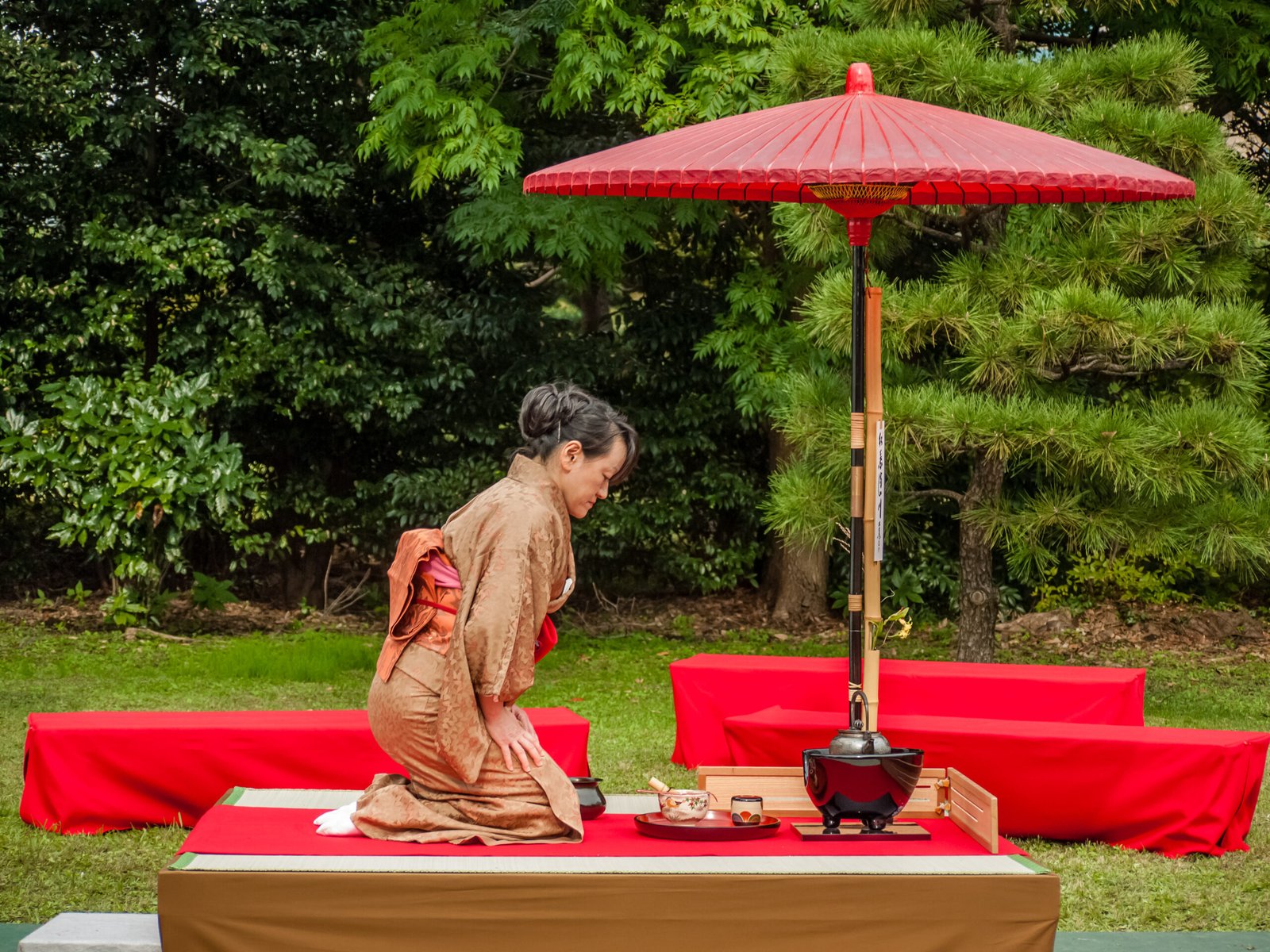
Omotenashi meaning (おもてなし) — Japan’s philosophy of selfless, wholehearted hospitality, in which the host gives completely with no expectation of return.
Japanese | おもてなし
IPA: /o.mo.te.na.ɕi/
Literal translation: “Without a surface” — to serve wholeheartedly, with no hidden face or ulterior motive
Etymology
Omotenashi (おもてなし) derives from the classical Japanese verb motenasu (もてなす), meaning to treat, to entertain, or to serve a guest. The word is parsed into two components: omote (表), meaning face, surface, or outward appearance — and nashi (なし), meaning without. Together they describe a mode of hosting that is entirely transparent: to serve without a mask, without calculation, without any expectation of return. You give what you give because giving is complete in itself.
The term has deep roots in Japanese court culture of the Heian period (794–1185 AD), where elaborate rituals of hospitality governed interactions between the nobility. Over centuries it became embedded in the aesthetic philosophy of chado, the Japanese way of tea, where every movement of the host — from the placement of the kettle to the angle of the bowl presented to the guest — is considered an act of devotion. Sen no Rikyū, the 16th-century tea master who codified the tea ceremony, taught that omotenashi was not merely technique but a way of being: the host’s entire self in service of a single, unrepeatable moment shared with another person.
Omotenashi gained global recognition in September 2013 when television presenter Christel Takigawa used it during Japan’s bid presentation for the 2020 Tokyo Olympics. Her definition of omotenashi — selfless, proactive, invisible hospitality given with no expectation of return — introduced the concept to hundreds of millions of viewers overnight and sparked an international conversation about the philosophy of service.
Cultural Context
To experience omotenashi in its fullest form is to stay at a ryokan, Japan’s traditional inn. Before you arrive, the staff has noted your dietary preferences, adjusted the room temperature for the season, laid out slippers in your approximate shoe size, and set the bath to the temperature most guests prefer in this particular weather. No request is necessary — no bell to ring, no complaint to file. The host has already imagined your needs and silently answered them. This anticipatory quality — sensing what another person requires before they can articulate it — is the soul of omotenashi.
What distinguishes omotenashi from ordinary good service is the complete absence of transactional energy. In cultures where tipping is standard, hospitality is subtly shaped by the expectation of reward. In omotenashi, the host gives completely because giving is its own reward — because creating a moment of ease and beauty for another person is, in itself, a meaningful act. This connects omotenashi to broader Japanese values: musubi (the spirit of connection between people), the poignant awareness embedded in mono no aware that makes each moment feel precious, and the quiet discipline of kata, the ritualized forms that make grace habitual rather than occasional.
Omotenashi also operates at a societal scale. Japan’s remarkably clean public spaces, its punctual trains, and the widespread practice of returning found wallets intact to their owners are all expressions of a culture where attentiveness to others is not exceptional behavior — it is simply what it means to be a member of a community. The concept permeates daily life: how a shopkeeper wraps a gift with three precise folds, how a taxi driver opens your door before you can reach for the handle, how a restaurant server remembers which guest ordered which dish without writing it down.
How It’s Used Today
Omotenashi is widely invoked in Japanese corporate culture, hospitality training, and national tourism campaigns. Hotels, airlines, and retail businesses train staff explicitly in its principles, and it is studied internationally by hospitality professionals seeking to understand Japan’s extraordinary service standards. The word now appears in business literature, cultural essays, and travel writing around the world.
「おもてなしの心で、お客様をお迎えしましょう。」
“Let us welcome our guests with the spirit of omotenashi.”
Why English Has No Equivalent
“Hospitality” describes a category of behavior. “Service” implies a transactional obligation between provider and recipient. “Generosity” focuses on the giver’s virtue rather than the guest’s experience. None of these words capture omotenashi’s essential quality: the total dissolution of the host’s ego into the guest’s wellbeing. English has words for individual acts of welcome, but no single term for the philosophy that elevates hosting into a form of selfless love — a love that asks for nothing in return and reveals itself only in the perfect moment it creates.
Related Words
If omotenashi resonates, you may also love omoiyari, the Japanese art of empathetic anticipation — imagining another’s feelings before they speak them, which is the inner engine of omotenashi itself. The concept of ma (間), the meaningful pause in Japanese aesthetics, shapes how silence and space are handled in omotenashi environments. Wabi-sabi informs the aesthetic sensibility that makes a simple tea bowl feel like a profound gift. You might also explore kodawari, the relentless attention to craft that underpins exceptional Japanese hospitality, and shokunin, the spirit of the artisan who serves their work before themselves. And nagomi (和み), Japan’s concept of quiet harmony and gentle calm, names the atmosphere that omotenashi creates at its most perfect — that sense of complete ease that settles over a guest who has been perfectly cared for.
Further Reading
- Etymology of “hospitality” — Online Etymology Dictionary — traces the Latin and Old French roots of Western hospitality concepts and illuminates how they differ from omotenashi’s ego-free philosophy
- Omotenashi — Japan National Tourism Organization — the official introduction to Japan’s hospitality philosophy for international visitors, with cultural context and examples