Uitwaaien Meaning & Definition
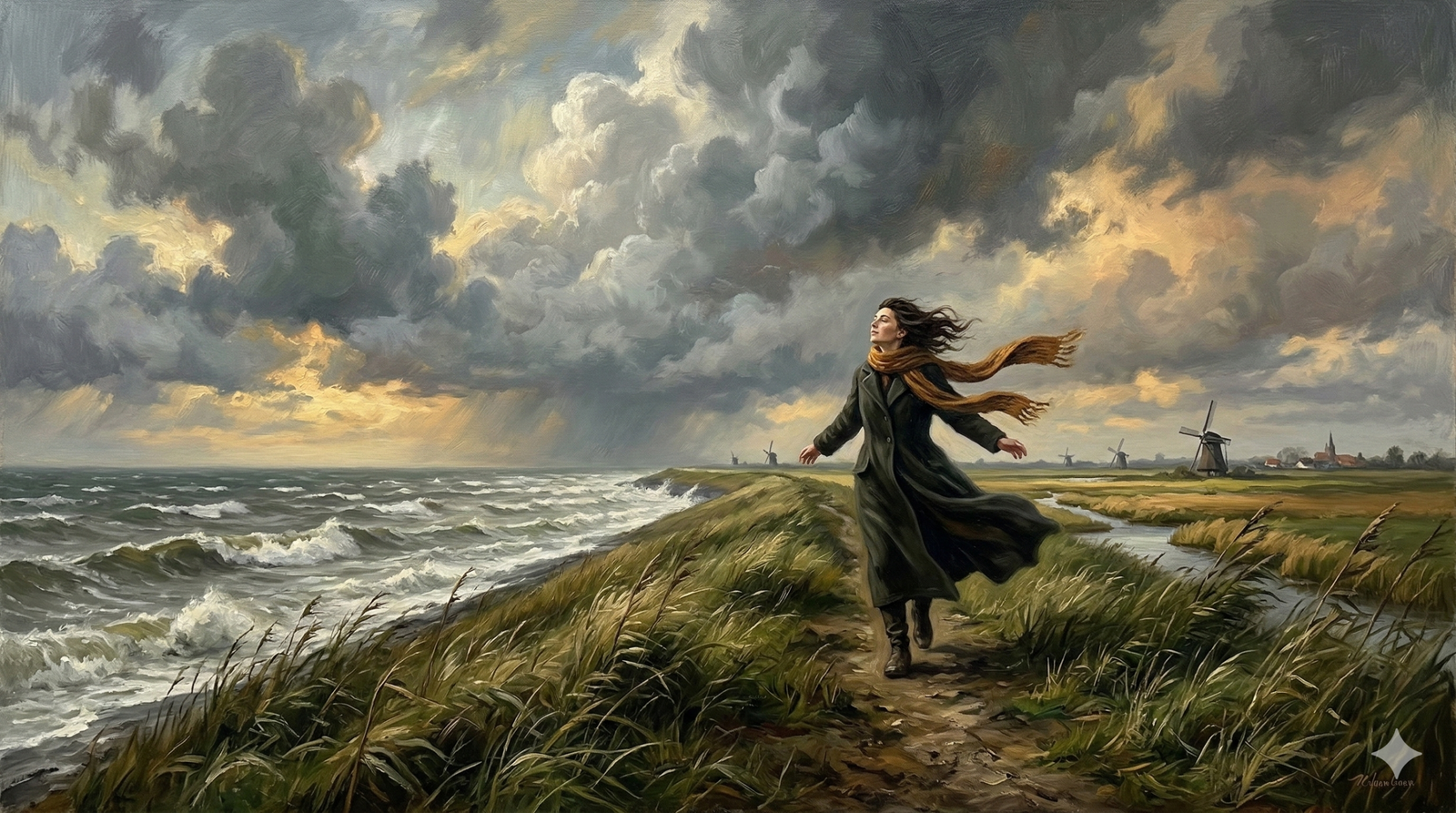
The uitwaaien meaning is deceptively simple and quietly radical — to go outside in windy weather, especially into nature, for the sole purpose of clearing your mind. It is not exercise. It is not a commute. It is the deliberate choice to walk into the wind and let it carry away whatever has been weighing on you. In the Netherlands, where flat landscapes and coastal proximity make wind an everyday companion rather than an inconvenience, uitwaaien is a deeply ingrained cultural practice — a form of mental hygiene as natural as brushing your teeth.
Pronunciation
IPA: /ˈœyt.ʋaː.jən/
Audio: Recommended — listen on Forvo for native Dutch pronunciation. The uit sounds roughly like “out” but with rounded lips (rhymes with “howt”), waai rhymes with “why,” and en is a soft, unstressed “uhn.” The full word flows as: OUT-why-uhn, spoken briskly, the way a gust moves through.
Etymology
The uitwaaien meaning has evolved beautifully over five centuries of Dutch usage. The word is a compound of uit (“out”) and waaien (“to blow”), giving the literal sense of “blowing out” or “airing out.” The verb waaien descends from Middle Dutch wāyen, which traces back through Proto-Germanic *wēaną to the Proto-Indo-European root *h₂weh₁-, meaning “to blow.” This same ancient root produced Latin ventus (wind), Sanskrit vā́ti (“it blows”), and eventually the English words “wind,” “weather,” and “ventilate.”
When uitwaaien first appeared in Dutch around 500 years ago, its meaning was purely physical — a flag flapping in the wind, or the act of blowing out a candle. By the 1800s, the word had expanded to describe freshening up clothes on a drying line in the breeze. But by the late 19th century, something shifted: the Dutch began applying uitwaaien to people. You could uitwaaien yourself — step outside and let the wind refresh not just your lungs but your mind. By the early 20th century, the uitwaaien meaning had completed its transformation from a description of physical objects to a philosophy of mental restoration.
Literal Translation
Uit (out) + waaien (to blow) = “to blow out” or “to be blown out.” The beauty of the uitwaaien meaning lies in this dual sense — you are both going out into the wind and letting something be blown out of you. The Dutch hear both meanings simultaneously: the outward movement into nature and the inward release of tension, clutter, and heaviness. No single English phrase captures this elegant reciprocity between the wind’s force and the walker’s surrender to it.
Cultural Context
To understand the uitwaaien meaning, you have to understand the Netherlands. This is a country where roughly a quarter of the land sits below sea level, where vast flat polders stretch to every horizon, and where the North Sea wind is a constant, living presence. The Dutch did not have the luxury of hiding from the wind — their landscape offers almost no shelter. So they did something characteristically practical: they made friends with it. Uitwaaien is the cultural expression of that friendship.
The practice requires no special equipment, no subscription, and no instruction. You simply go outside — ideally to a beach, a dike, an open field, or a canal path — and walk. The wind does the rest. The Dutch treat uitwaaien the way other cultures treat meditation or therapy: as a reliable, accessible reset button for the mind. A 2021 study published in the International Journal of Environmental Research and Public Health found that exposure to wind and outdoor weather elements significantly reduced stress markers and improved mood — something the Dutch have known intuitively for centuries.
Uitwaaien carries no negative connotation in Dutch culture. Unlike the English phrase “going out in bad weather,” which implies something unpleasant or foolish, uitwaaien is always positive. It is prescriptive — Dutch parents tell their children to go uitwaaien the way American parents say “go play outside.” It is therapeutic — friends recommend it after a bad day at work. And it is democratic — it costs nothing, takes no skill, and works regardless of age, fitness, or mood. The only requirement is wind, and in the Netherlands, that is never in short supply.
Modern Usage Example
Dutch: “Ik heb even nodig om uit te waaien — het was een zware week.”
English: “I need to go uitwaaien for a bit — it’s been a tough week.”
Dutch: “Laten we naar het strand gaan om lekker uit te waaien.”
English: “Let’s go to the beach for a good uitwaaien.”
Related Words
If the uitwaaien meaning speaks to you, explore these kindred concepts from our dictionary: Gezellig (Dutch) — the warm, convivial atmosphere that often awaits you when you come back inside after uitwaaien. Gökotta (Swedish) — another Scandinavian tradition of seeking nature at specific times, this one for birdsong at dawn. Waldeinsamkeit (German) — the feeling of solitary communion with nature, a forest cousin to uitwaaien’s open-air wind walk. Lagom (Swedish) — the Nordic principle of “just enough” that shares uitwaaien’s unpretentious wisdom.
Why English Needs This Word
English has “a breath of fresh air” and “clearing your head,” but these are vague metaphors that lack intention. The uitwaaien meaning names something specific: the conscious choice to use wind and weather as instruments of psychological renewal. In an age of meditation apps, sound baths, and breathwork classes, uitwaaien is startlingly analog — no technology, no technique, no teacher. Just you and the wind and the ancient bargain between them. The Dutch understand something the rest of the world is only beginning to rediscover: that nature is not merely scenery for our wellness routines. Sometimes, the best thing you can do for your mind is to walk straight into the storm and let it take what it wants.